Posts

Time Lapse 1

Image
A pair of House Finches ( Carpodacus mexicanus ) snack on safflower seed at the BirdCam station.  But this is not the only interesting activity in the photo.  In the background is Rhododendron 'Kristin ' just beginning to open.  If things work out, I will post additional photos as the flower trusses continue to develop. 'Kristin' is a hybrid of R. yakushimanum .  These are hardy and beautiful rhodies that come from Yakushima Island in the Japanese archipelago.  The island is a World Heritage Site with a number of features in common with Washington's Olympic Peninsula: Both sites have an indigenous Rhododendron species Both have a unique species of deer (Roosevelt Elk, Sika Deer) Each experiences high rainfall producing temperate rain forests Both sites are mountainous and contain national parks Both feature gigantic, ancient conifers Yakushimanum species and hybrid rhodies are beautiful and easy to grow.  They are moderate in size, perfect f...
Silent Spring

Image
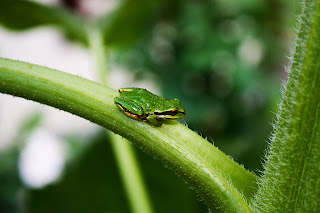
Pacific Chorus Frog ( Pseudacris regilla ) "There was once a town in the heart of America where all life seemed to live in harmony with its surroundings." "Then a strange blight crept over the area and everything began to change.  Some evil spell had settled on the community;" "There was a strange stillness.  ...there was now no sound; only silence lay over the fields and woods and marsh." -Rachel Carson, Silent Spring, 1962 I was in high school when Silent Spring was published.  It was a sensation.  It became THE book to read.  President Kennedy mentioned it in a press conference.  Despite the howling of the chemical industry, the President's Science Advisory Committee confirmed Rachel Carson's findings.  Human activity can have a profound impact on nature.  The book literally changed history, and created a lasting public awareness of nature and the environment.  Those were the days when decisions were based on science, data and ...

Tulip Time

Image
This post may offend some readers.  Don't expect the usual glowing travelogue.  There are no tulips in my garden.  Just the thought of them makes me cringe.  I dread the approach of April, because it means the Skagit Valley Tulip Festival will be commencing.  For this one month of the year, I become a xenophobe.  Thousands of tourists will come to view these "Lilies of the Fields," oblivious to the lesson they may teach.  Don't expect to find meditation and introspection in this sermon.  Instead, picture a horde of desperate ants on a food source. To some of us who live here, it is really the Skagit Valley Traffic Festival.  Unless you enjoy traffic jams, it is wise to stay away during April weekends.  Draw a square defined by Interstate 5 between Conway and Burlington, State Road 20, the La Conner Channel and Fir Island Road.  Inside that zone, don't be surprised to find total pandemonium.  Some visitors believe that travel...

Wild Fidalgo:  You Again!

Image
Eastern Gray Squirrel ( Sciurus carolinensis ) I was wondering how long it would take this guy to discover that there were sunflower seeds back at the BirdCam station.  It took him a little more than two weeks.  You're slipping up there, fella.  Looks like it's time to switch to safflower seed again.  We'll see what that will attract now that the spring birds are starting to return. Weather Statistics for March, 2011 Temperature High 61.3° F Low 33.7° F Mean 45.4° F Rainfall 1.69 inches Wind High 37 mph Average 3.9 mph Dom Dir S Observed at South Fidalgo Island (See Climate page for complete climatological data)

A Day at the Park:  The Bridge at Deception Pass

Image
After a very long winter, the sun came out on March 23rd.  This beautiful day was a perfect excuse to visit one of my favorite places, Washington's Deception Pass State Park.  From my home on South Fidalgo Island, it is only a 10 minute drive away.  The park straddles both sides of Deception Pass with sections on Fidalgo and Whidbey Islands.  From the parking lot at Bowman Bay, I hiked the trails to Lighthouse Point and to Rosario Beach .  The visit continued to the top of Rosario Head .  Before heading home, I decided to make a quick stop at the bridge to catch some shots in the sunny weather.  You may have noticed that an image of this local icon appears in the header of this blog. The Deception Pass Bridge connects Fidalgo to Whidbey Island along State Highway 20.  It is listed on the National Register of Historic Places .  There are actually two spans situated at an angle.  Between the spans is Pass Island, basically a big roc...

A Day at the Park:  Rosario Head Part 2

Image
We continue exploring Rosario Head at Deception Pass State Park.  In the last post , we arrived at Rosario Beach via the Rosario-Bowman Bay Nature Trail.  Beyond the Samish story pole are two trails that lead to the top of Rosario Head.  There is a sign on the left trail warning of danger.  This is puzzling to me since there is actually less danger here than we have already encountered.  Perhaps there was an accident and the sign was put up in response.  From high above the water there are stunning views of Whidbey Island, the Olympic Mountains and the San Juan Islands.  Best come in early morning to photograph the mountains.  Exposed volcanic rocks dot the waterways all around this viewpoint.  In the photo, these will be nesting sites for seabirds and are off-limits to visitors.  On the horizon are the San Juan Islands. The trees up here reveal the stresses on this exposed headland.  It is built of solid stone with v...

A Day at the Park:  Rosario Head Part 1

Image
It is still March 23rd which delivered this beautiful, sunny day.  We continue exploring the nature trails around Bowman Bay in Deception Pass State Park.  This time, the destination is Rosario Head .  We set off heading north from the parking lot and cross the picnic grounds.  The park was built in the 1930's by men of the Civilian Conservation Corps .  The CCC Interpretive Center is housed in a building that formerly served as a bathhouse and comfort station for CCC workers.  Today, the lawns here were sparkling with little white flowers. The lawn weeds are English Daisy ( Bellis perennis ) which are not natives.  They were introduced from Europe.  Man, those English really spread their seeds around the planet, didn't they?  According to Pojar , the word daisy is derived from "day's eye" or "eye of the day," because the blossoms open and close in changing daylight. Continue across the picnic grounds close to the shoreline to pi...