Posts

Showing posts with the label BirdCam

Predator

Image
Arguably, the film Predator gave us one of the greatest movie creatures ever.  It took cunning and some luck for Arnold to defeat it.  Our wildlife gardens can also contain predators that are as malevolent and ruthless as that alien creature in the movie.  Domestic cats that are allowed to run free are known to exercise their predatory instincts.   One blogger did the math and came up with an estimate of 1.7 billion birds killed by outdoor cats annually in the United States.  If you think that is an overestimation, divide it by 1,000 and the number is still too large. If cat lovers are not feeling a little concerned by that number, perhaps they will take notice of these figures : Free-roaming cats live 1 to 3 years Indoor/outdoor cats live 6 to 8 years Indoor only cats live 20 years or more My neighborhood serves as an example.  When I first moved here, there were several cats, perhaps a dozen, that roamed the area.  I came to recognize t...

Birdcam Back in Business

Image
My two Birdcam photo stations have been shut down since mid-February.  Recall the problems I was having with Eastern Gray Squirrels and House Finches.  Too much success can be the worst dilemma of all.  I decided to give all bird feeding a cooling down period.  This week, I began setting up my Birdcam stations again.  Station No. 2 now has a brand new woodpecker feeder and I provisioned it with pepper suet .  I have been experimenting with it for a couple of months, and the Gray Squirrels have shunned it totally. I was pleased to catch this photo of a Pileated Woodpecker ( Dryocopus pileatus ) on the first day out.  This is the bird that inspired me to purchase and install a Birdcam in the first place.  This is also my first photo of a female Pileated.  The black mustache and black forehead are the distinguishing marks.  Until now, I had only seen males in the yard.  Yes, friends, I am definitely back in business. The Bl...

Birdcam Sabotage and a Lesson

Image
Webster's New World Dictionary defines "sabotage" in part as: "Destruction of railroads, bridges, machinery, etc., as by enemy agents or an underground resistance." "The deliberate obstruction of or damage to any cause, movement, activity, effort, etc." This is the current state of affairs at my Birdcam 2 station in the back yard.  The key words in the definition are "enemy agents," "deliberate," and "damage."  In this case, the enemy agents are the non-native Eastern Gray Squirrels ( Sciurus carolinensis ): This Birdcam photo shows the suet feeder under attack when it was still relatively undamaged.  For several weeks I had been getting virtually nothing but squirrel photos at the Birdcam from dawn to dusk.  Two entire cakes of suet would be consumed in a single day.  The situation was insufferable.  I took some steps to try to solve the problem.  You can see these in the photos: I used a more robust lat...

Wild Fidalgo:  Northern Flicker Paradigms

Image
From Wild Fidalgo , is this Northern Flicker ( Colaptes auratus ) red-shafted, yellow-shafted or a little of both?  How many distinguishing characteristics can you spot?  Is this a male or female?  Some of the first photos caught at a new BirdCam station  are posted at Wild Fidalgo and provide an exercise in Northern Flicker taxonomy.

Time Lapse 10

Image
The blossom trusses of Rhododendron 'Kristin' are now fully opened.  The BirdCam caught this photo without wildlife which I thought would be fitting to complete the series.  Over the next couple of weeks, the blossoms will fade and drop leaving seed heads.  Gardeners routinely remove these seed heads to encourage new growth.  The process is referred to as "dead-heading." Another R. yakushimanum hybrid, Rhododendron 'Aloha,'  is beginning to open in the background.  There are currently eleven Yak rhodies in this section of the garden, with room left for a few more.

Time Lapse 9

Image
The sun has finally emerged from behind the overcast to brighten the opening blossoms of Rhododendron 'Kristin.'  Above, a House Finch ( Carpodacus mexicanus ) and an American Goldfinch ( Carduelis tristis ) are in their best breeding colors.  Later in the day when the light has changed, a Townsend's Chipmunk ( Tamias townsendii ) strikes an uncharacteristically wary pose.  I wonder if they hear noises from the BirdCam.

Time Lapse 8

Image
A Black-headed Grosbeak ( Pheucticus melanocephalus ) makes his BirdCam debut while the Rhododendron 'Kristin' blossoms continue to open.  According to iBird, these birds prefer open deciduous woodlands near water, with a mixture of trees and shrubs.  This aptly describes the small wetland habitat across the road.  They are fond of safflower seed which is currently stocked at the BirdCam station.  They are not year-around residents on South Fidalgo, but a few come every spring and summer.  This is a male in breeding condition.  Above, the BirdCam also caught something flying off in the upper left corner.  Below, he has a tortoiseshell appearance from the back.

Time Lapse 7

Image
Though slightly rain-bedraggled, the Rhododendron 'Kristin' blossoms continue to open.  Today's photos offer studies in style.  Above, the muted tones of House Sparrow females ( Passer domesticus ) offer a contrast to the bright, flashy American Goldfinch ( Carduelis tristis ) below.  House Sparrows are also known as English Sparrows.  They were introduced from England, becoming one of two "Old World" sparrows from the family Passeridae in North America.  Native sparrows all belong to the family Emberizidae.

Time Lapse 6

Image
Today I have two photos of the blossoming Rhododendron 'Kristin."  Above, a Spotted Towhee ( Pipilo maculatus ) is almost lost in the floral display.  Below one of the local Pine Siskins ( Carduelis pinus a.k.a. Spinus pinus ) returns to enjoy some safflower seed.

Time Lapse 5

Image
Blogger hiccups and my work schedule notwithstanding, the flower trusses of Rhododendron 'Kristin' are beginning to take shape.  Meet Townsend's Chipmunk ( Tamias townsendii a.k.a. Neotamias townsendii ) who has become a daily habitué at the BirdCam station.  He's a bold little fellow allowing me to get very close.  He has apparently decided I am not a threat.  The feeling is mutual.

Time Lapse 4

Image
The individual blossoms of Rhododendron 'Kristin' are now visible.  In Rhododendrons, they form in clusters called trusses at the ends of the stems.  A Song Sparrow ( Melospiza melodia ) attired in drab business pinstripes is almost rendered invisible by the developing display.

Time Lapse 3

Image
The blossoms of Rhododendron 'Kristin' continue to open while a camera-shy trio of American Goldfinches ( Carduelis tristis ) look on.  Goldfinches are just beginning to arrive this week.  They are among the latest nesting birds, starting in late June or early July according to iBird .

Time Lapse 2

Image
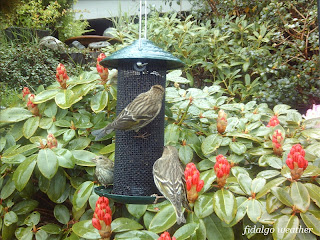
The blossoms of Rhododendron 'Kristin' continue to open while Pine Siskins ( Carduelis pinus ) enjoy some thistle seed.  The genus name Carduelis  comes from Carduus and refers to the birds' taste for thistle seed.

Time Lapse 1

Image
A pair of House Finches ( Carpodacus mexicanus ) snack on safflower seed at the BirdCam station.  But this is not the only interesting activity in the photo.  In the background is Rhododendron 'Kristin ' just beginning to open.  If things work out, I will post additional photos as the flower trusses continue to develop. 'Kristin' is a hybrid of R. yakushimanum .  These are hardy and beautiful rhodies that come from Yakushima Island in the Japanese archipelago.  The island is a World Heritage Site with a number of features in common with Washington's Olympic Peninsula: Both sites have an indigenous Rhododendron species Both have a unique species of deer (Roosevelt Elk, Sika Deer) Each experiences high rainfall producing temperate rain forests Both sites are mountainous and contain national parks Both feature gigantic, ancient conifers Yakushimanum species and hybrid rhodies are beautiful and easy to grow.  They are moderate in size, perfect f...

Wild Fidalgo:  You Again!

Image
Eastern Gray Squirrel ( Sciurus carolinensis ) I was wondering how long it would take this guy to discover that there were sunflower seeds back at the BirdCam station.  It took him a little more than two weeks.  You're slipping up there, fella.  Looks like it's time to switch to safflower seed again.  We'll see what that will attract now that the spring birds are starting to return. Weather Statistics for March, 2011 Temperature High 61.3° F Low 33.7° F Mean 45.4° F Rainfall 1.69 inches Wind High 37 mph Average 3.9 mph Dom Dir S Observed at South Fidalgo Island (See Climate page for complete climatological data)

Wild Fidalgo:  Seeing Spots

Image
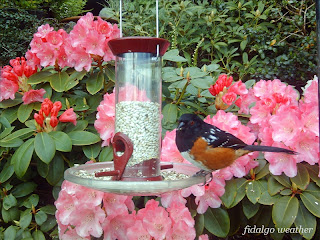
An atypical Spotted Towhee ( Pipilo maculatus ) has made an appearance at the BirdCam station.  Our local oregonus subspecies is the least spotted of all.  This spottier bird is more typical of those seen in the Rocky Mountain, Great Basin, southern California and Great Plains regions.  An Oregon birder has had the same experience.  For more details about this apparent wanderer, check his story at Wild Fidalgo .

Wild Fidalgo:  The BirdCam Catches Winter Weather

Image
Red-shafted Northern Flicker ( Colaptes auratus ) From Wild Fidalgo , the BirdCam catches some avian visitors during a stretch of unseasonal winter weather.  Although we have gotten snow as late as April here, even February snowfall is rare.  The February 23rd storm dropped as much as 14 inches/36 cm in some areas of lowland western Washington.  For a time on Wednesday evening, 30 miles of Interstate 5 was shut down between Arlington and Alger where drivers were overwhelmed by the conditions.  South Fidalgo received about 6 inches/15 cm during the storm.  Temperatures have remained below freezing.  February is normally rainy and overcast with temperatures in the 40's and 50's F (4° to 13° C).  Occasional sun breaks provide evidence that spring is on the way.  Tomorrow promises to bring back normal temperatures and very welcome rain, under the circumstances.

Checking It Out at Wild Fidalgo

Image
Song Sparrow ( Melospiza melodia ) Winter birds are checking out the new BirdCam feeder at Wild Fidalgo .

Wild Fidalgo:  Snow Day

Image
 Spotted Towhee ( Pipilo maculatus ) From Wild Fidalgo , despite unseasonal cold weather and snow, the birds must continue to make a living.  They never get a snow day or a Thanksgiving holiday.  Have a great Thanksgiving Day everyone.

Eastern Gray Squirrel

Image
From Wild Fidalgo , athletic Eastern Gray Squirrels ( Sciurus carolinensis ) have become adept at raiding the bird feeders.